Rivian's June quarter bottom line saved by software sales
There is a serious issue at the heart of building electric vehicles right now: stamping heavy sheet metal and bolting multi-link suspensions onto a chassis makes you bleed cash, but writing elegant lines of code makes you wealthy. The monstrous presses that punch out body panels - they are the brutal, high-capital reality of the physical car business. But it is the digital wizardry hidden away inside the dashboard that keeps the lights on.
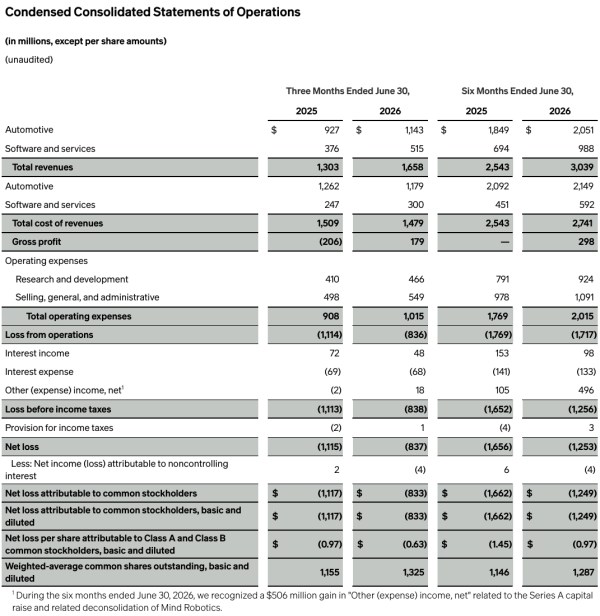
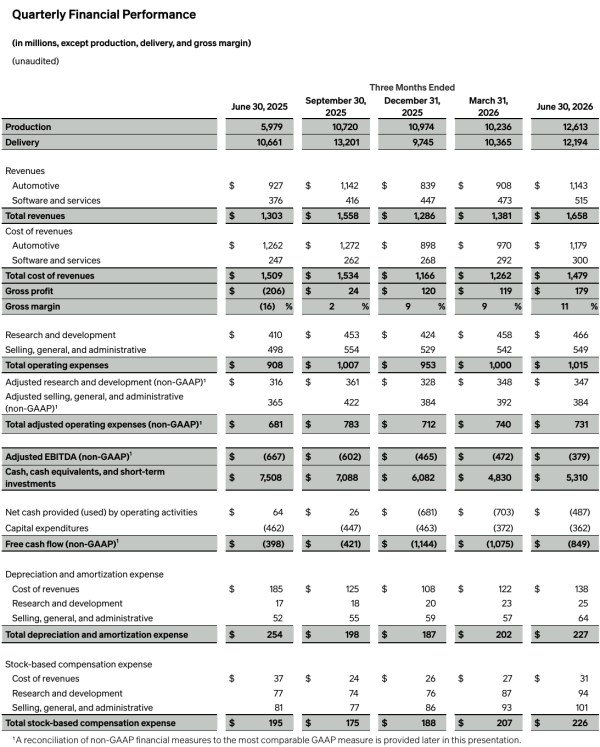
Rivian's latest earnings outline this modern tension beautifully, proving that building rugged trail-hustlers is the soul of the company, but selling software is the engine that actually keeps the balance sheet from spinning off into red. Total revenue shot up by 27 percent to hit a healthy $1.658 billion, comfortably outpacing the $1.51 billion the analysts on Wall Street were predicting.
 Source: Rivian
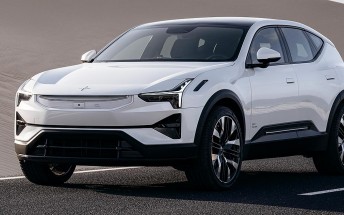
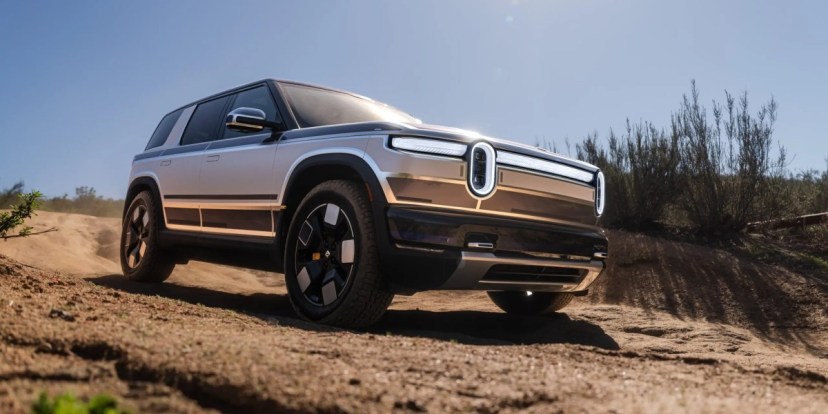
Sure, the real headline grabber is the long-awaited arrival of the R2 SUV, which finally began trickling out to customer driveways on June 9. This is the vehicle meant to democratize Rivian's rugged, overland charm, sliding neatly under the critical $50,000 threshold to mount a direct assault on the mainstream market. Launching a volume EV right now is a brave roll of the dice - especially in a cooling United States market where tax incentives have expired, and buyers are suddenly clutching their wallets a bit tighter.
The hunger for this smaller rig looks intensely real, with Rivian hosting a company-record 57,000 demo drives during the quarter, turning customer curiosity into a pile of firm order conversions that blew way past even most optimistic projections.
 Source: Rivian
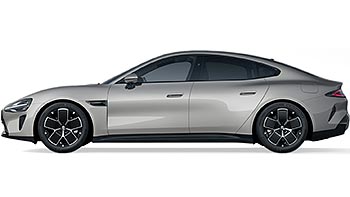
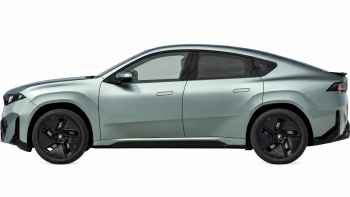
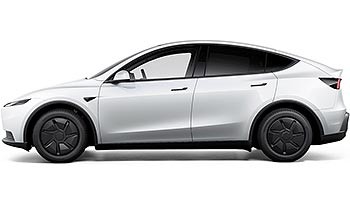
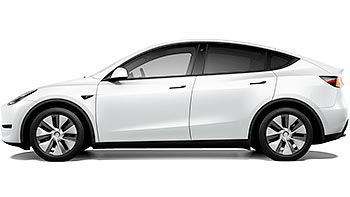
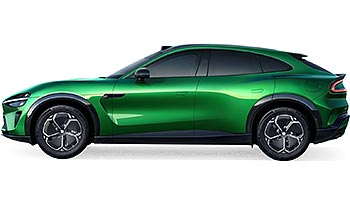
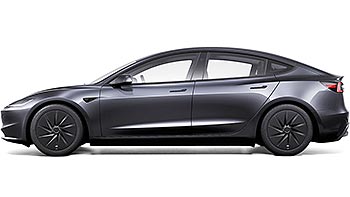
Standing next to a Tesla Model Y or a Hyundai Ioniq 5, the R2 stakes its claim as the traditionalist, boxy adventurer of the group. At 185.6 inches in length, the R2 is slightly shorter and tighter to park than the sleek Model Y, though it commands a bit more presence than the retro-futuristic Hyundai Ioniq 5. Rivian has engineered the R2 to look and feel like a proper SUV rather than a blown-up hatchback - it towers above the competition with a height of 66.9 inches. More importantly, the R2 has an aggressive 9.8 inches of ground clearance - an old-school off-road stance that leaves the Model Y looking distinctly suburban.
Of course, turning on a brand-new assembly line is never a cheap date, and the automotive side of the ledger shows the scars of scaling up. Rivian's vehicle manufacturing operations brought in $1.143 billion in revenue for the quarter, but the division ultimately ran a gross loss of $36 million. Bring up a new vehicle line from a dead stop and you swallow some serious upfront pain - in this case, Rivian absorbed roughly $100 million in heavy introductory manufacturing costs just to get the R2 line running smoothly.
 Source: Rivian
If we are being completely honest, the underlying picture gets a bit muddier, given that $108 million of Rivian's revenue was propped up by selling regulatory compliance credits to legacy manufacturers. Take those away, and the true loss lands closer to $140 million - a painful reminder of how much cash a factory burns before the economies of scale kick in.
Before anyone starts writing a eulogy for the brand, let's look at the software and services division. This is where the true financial magic happened, with digital revenues climbing 37 percent year-over-year to hit $515 million. The real savior here was Rivian's joint venture with the Volkswagen Group, which injected $308 million directly into the pot. Because software carries massive margins - clocking in at a jaw-dropping 42 percent this quarter ($215 million in pure profit) - the digital team effectively carried the entire corporate balance sheet, lifting Rivian to a record total consolidated gross profit of $179 million.
 Source: Rivian
This giant cash cushion gives Rivian the breathing room to face the mountain of a production target they have set for the rest of the year. Management confidently bumped the full-year delivery forecast up to a range of 65,000 to 70,000 vehicles, up 3,000 units from the previous estimates. But if you sit down and do the cold, hard second-half math, you realize the factory floor is about to get really busy.
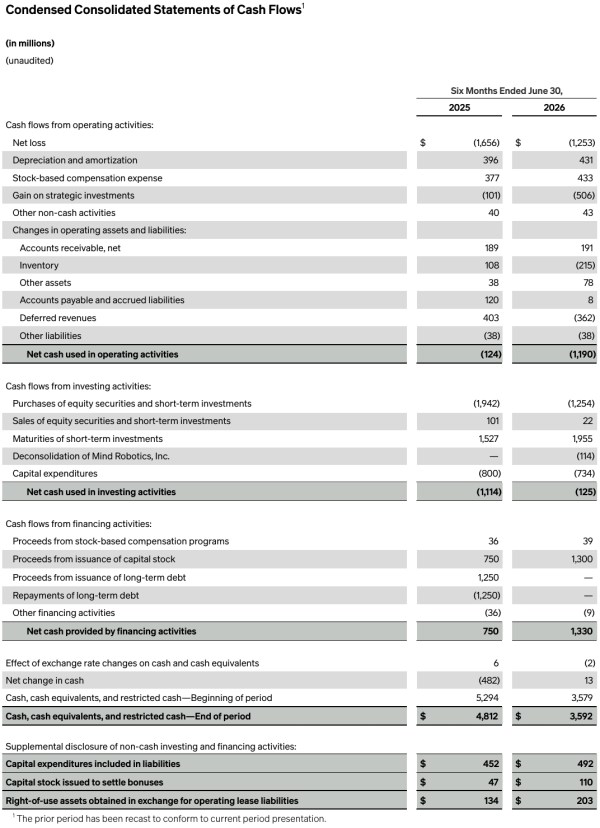
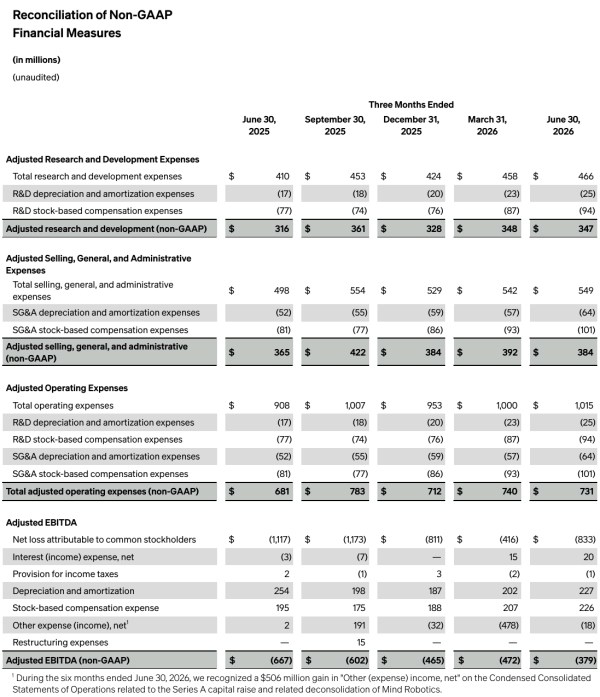
Having delivered 22,559 vehicles over the first six months of the year, Rivian now needs to deliver between 42,000 to 47,000 units in the final two quarters alone. That means nearly doubling their year-to-date pace in the exact same timeframe, a logistical marathon that will need every single assembly robot to run at maximum tilt. Rivian even managed to narrow their full-year adjusted EBITDA loss guidance to a range between $1.8 billion and $2.0 billion, and shaved capital expenditure expectations down to a leaner $1.7 billion to $1.8 billion window.
 Source: Rivian
Looking back at Rivian's history, the switch to volume is the make-or-break moment they have been building toward for a decade. They burst onto the scene with the brilliant but pricey R1T truck and R1S SUV, proving they could build desirable, premium lifestyle machines, but they also learned the agonizing lesson of high cash burn at their facility in Normal, Illinois.
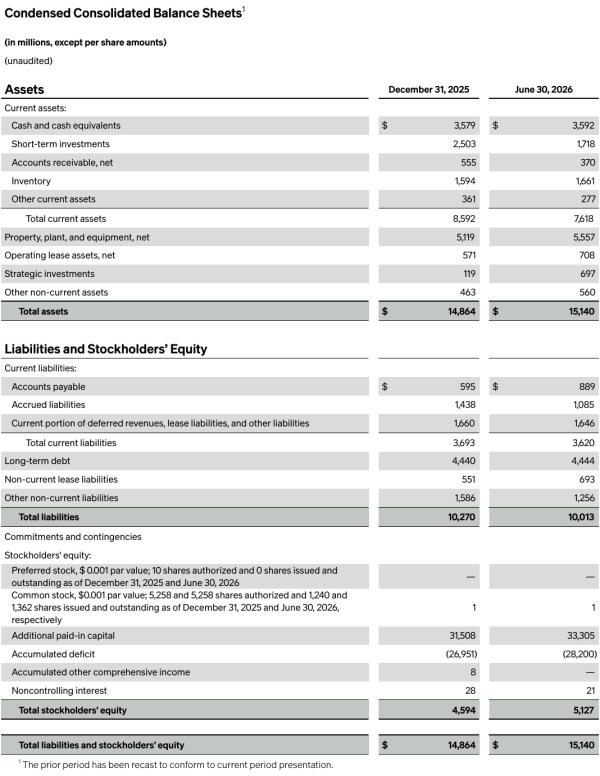
The mass market needs a completely different strategy, which is why the R2's bill of materials is engineered to cost roughly half of what it takes to build an R1. To fund this transition and keep building out the new factory in Georgia, the company has assembled a $14 billion war chest, reinforced by a $1.3 billion stock sale, another $1 billion in non-recourse debt from Volkswagen, and a fresh $250 million equity investment from Uber. Free cash flow for the quarter sat at negative $849 million as they stacked R2 inventory, but with $5.31 billion in cash and short-term investments still sitting in the bank at the end of the quarter, the runway looks to be ready for takeoff.
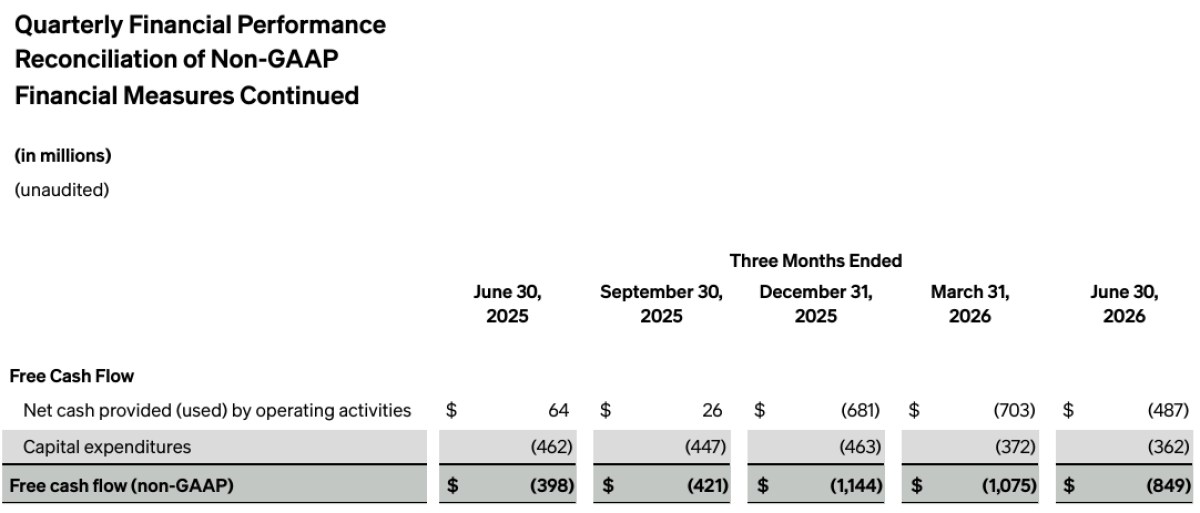 Source: Rivian
When we add up the final numbers, the overall net loss still sits at a hefty $837 million, or $0.63 per share, but in the volatile world of EV startups, this is actually a victory. Rivian beat Wall Street's gloomy predictions, and adjusted EBITDA rolled in at negative $379 million against the negative $548 million that analysts had modeled.
Investors clearly liked the results, pushing premarket shares up nearly two percent to $17.35. The transition from an expensive, low-volume boutique outfit into a profitable mass-market player is the hardest trick in modern automaking, but with five quarters in a row of climbing gross margins, Rivian is finally showing they have the engineering grit and the software brains to pull it off.
Related



Reader comments
- Anonymous
why are americans still stamping heavy sheet metal? using logarithmic metallurgy scale, usa should be on nanotech like tony stark's armor.
- 01 Aug 2026
- Bkx