Jeep New Compass e FWD review
Jeep, best known for its off-roading prowess and go-over-everything ethos, went a bit conservative for its first EV car. The brand relies on strong capabilities far from the paved roads, so the Avenger just felt a little too timid.
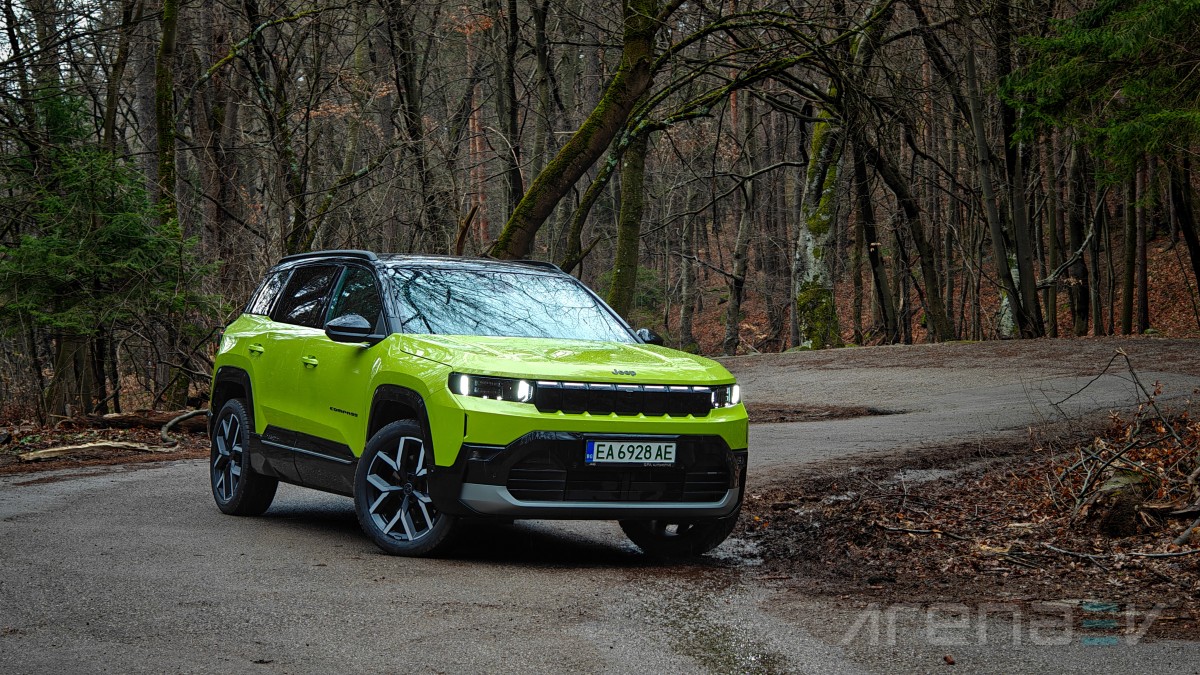
Table of Contents:
- Exterior
- Interior
- Storage & practicalities
- Driving experience
- Ride comfort
- Tech features
- Cabin noise
- Acceleration and braking
- Consumption
- Charging speed
- Competition
- Verdict
Enter the Jeep Compass, a name that emerged 20 years ago and offered high ground clearance and good interior space for a fraction of the price of Jeep’s bigger and mightier models. It came as a FWD model at first and an AWD version later came to make it every bit the Jeep car.
Today, the New Compass also debuts as a FWD model, with promises of an AWD variant heading into production next year. For the first time ever the Compass is offered as a fully electric vehicle, with a mild hybrid option available as well.
The model we tested is the Jeep Compass e FWD in First Edition trim, which brings with it nearly the full range of available equipment. The New Compass is sold alongside the outgoing generation due to sustained demand, which mandates the "New" designation in its name.
Jeep Compass 2025 -
- Dimensions: 179.2 inches x 75.9 inches x 65.9 inches, 110 inches wheelbase.
- Drivetrain tested: Front-wheel drive - FWD 157 kW (213 hp), 254 lb-ft, 73.7 kWh usable battery capacity, 79.9 kWh total battery capacity
- Charging: 160 kW CCS
- Range: 311 miles WLTP
- Weight: 4,846 lb unladen
- Other features: Massaging seats, Offroad settings, OTA updates.
Exterior
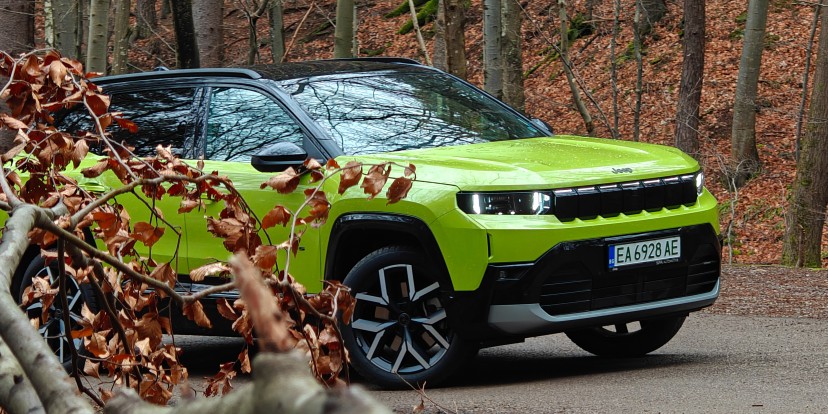
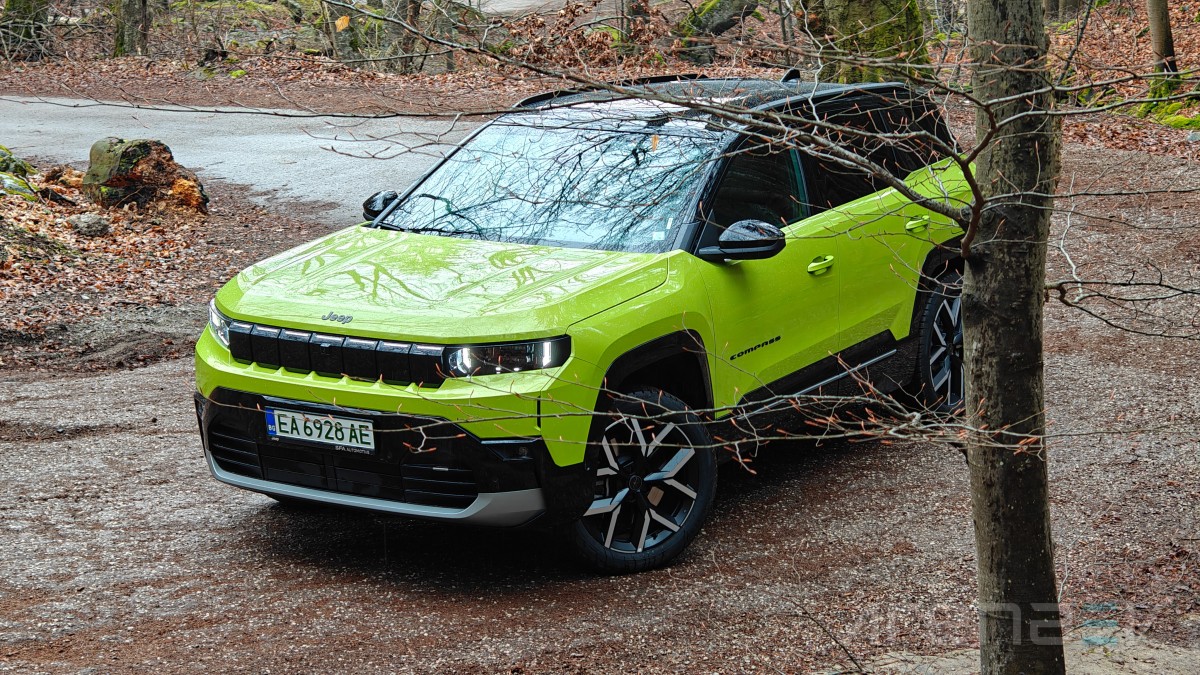
Jeep's strong exterior design heritage is carried to the New Jeep Compass, so it's instantly recognizable as part of the brand's lineup. In a world dominated by boring and bland midsize SUVs, Jeep is introducing a striking look, coupled with the standard Hawaii green color that makes the Compass stand out in traffic like few other SUVs.
The emblematic seven slot grille is no longer required for engine cooling, yet it has been retained as a purely design element to preserve the visual identity.
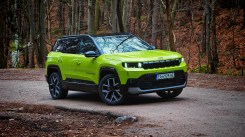
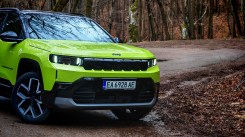
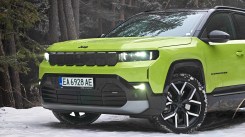
Jeep Compass e's front
The front bumper accommodates the actual cooling grilles and an active portion of it provides even more cooling when needed. It opens during hotter days, which unfortunately we didn't get in the wintry conditions while testing.
The signature rugged looks are underlined by the black underbody accents that make the Compass appear rugged and ready to be taken into the wilderness. Our test vehicle had them in gloss black, which is far from optimal to actually go off-road but that is an option and the standard version actually has them in regular matte black plastic that can take more beating.
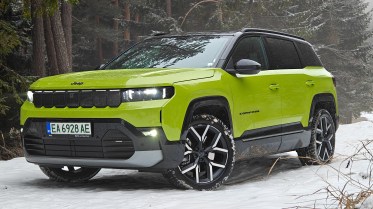
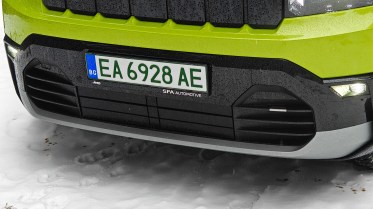
Jeep Compass e front grille
Even with the sub-optimal elements that bring the extra design flair Jeep optimized the exterior of the Compass to be as reasonably slippery, achieving a decent drag coefficient of 0.29 Cd. It is still far worse than most rivals but none of them offer a ground clearance of 7.9 inches and as much character.
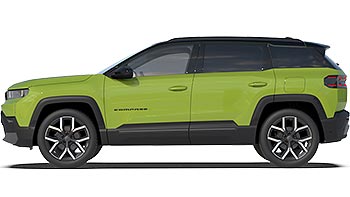
The side profile of the Jeep New Compass looks great thanks to the two-tone paint scheme. The Hawaii green body contrasts with the black roof and pillars and makes them "disappear" visually. If two-tone is not your thing, full Hawaii green is among the standard colors so you'll even be saving some money.
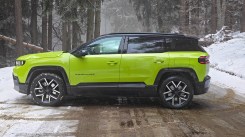
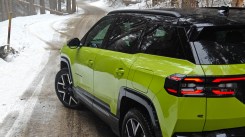
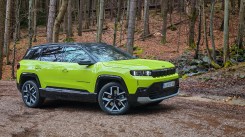
Jeep Compass e side
Color aside, the side of the Compass is beautifully simplistic and offers no surprises or extravagant door handle solutions.
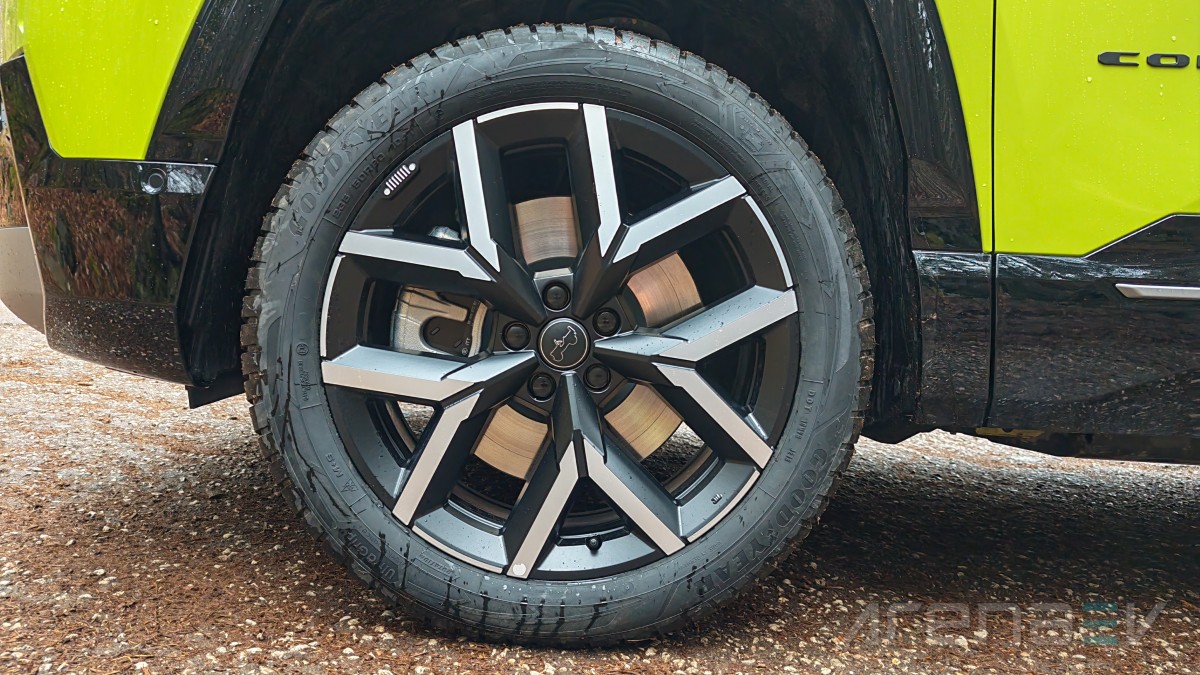
The new Jeep Compass is offered with either 19" or 20" wheels, our test vehicle being fitted with the larger option. Both sizes share the same design, making the visual difference minimal. For that reason, the smaller wheels are the more sensible choice, offering improved efficiency and ride comfort without damaging the appearance significantly.
The center caps of the wheel don't have a Jeep logo but instead an old Jeep Willys silhouette fills that spot. This shows both attention to detail and appreciation for heritage and we commend Jeep for incorporating such accents everywhere around the Compass.
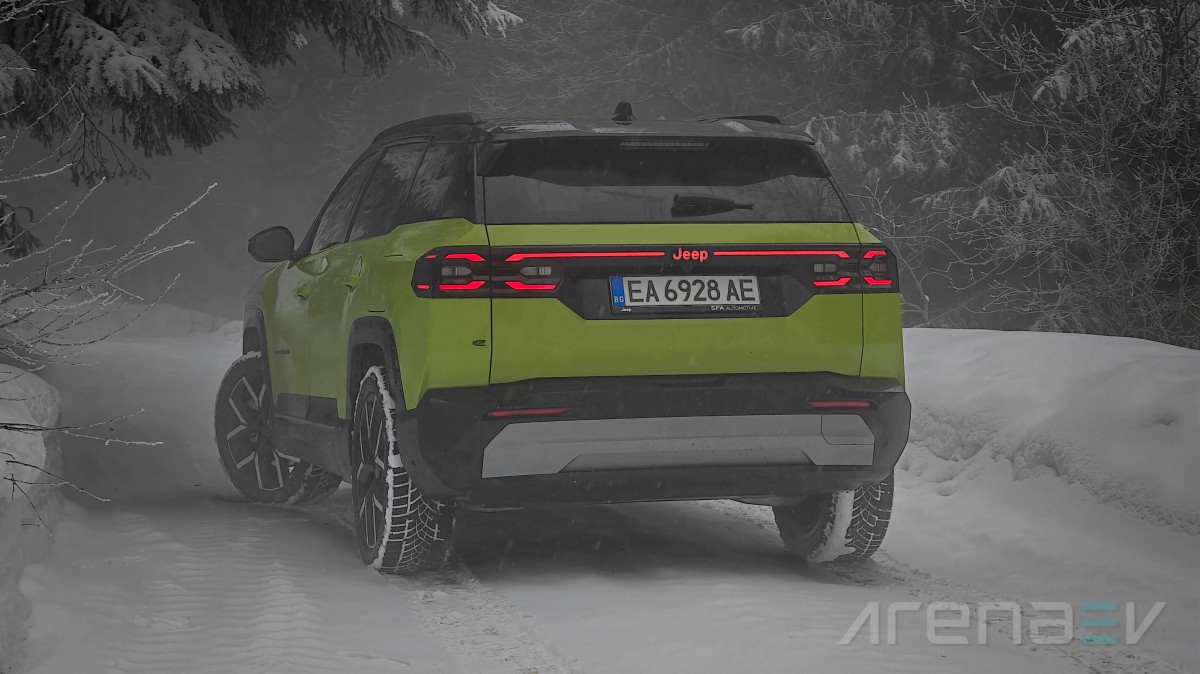
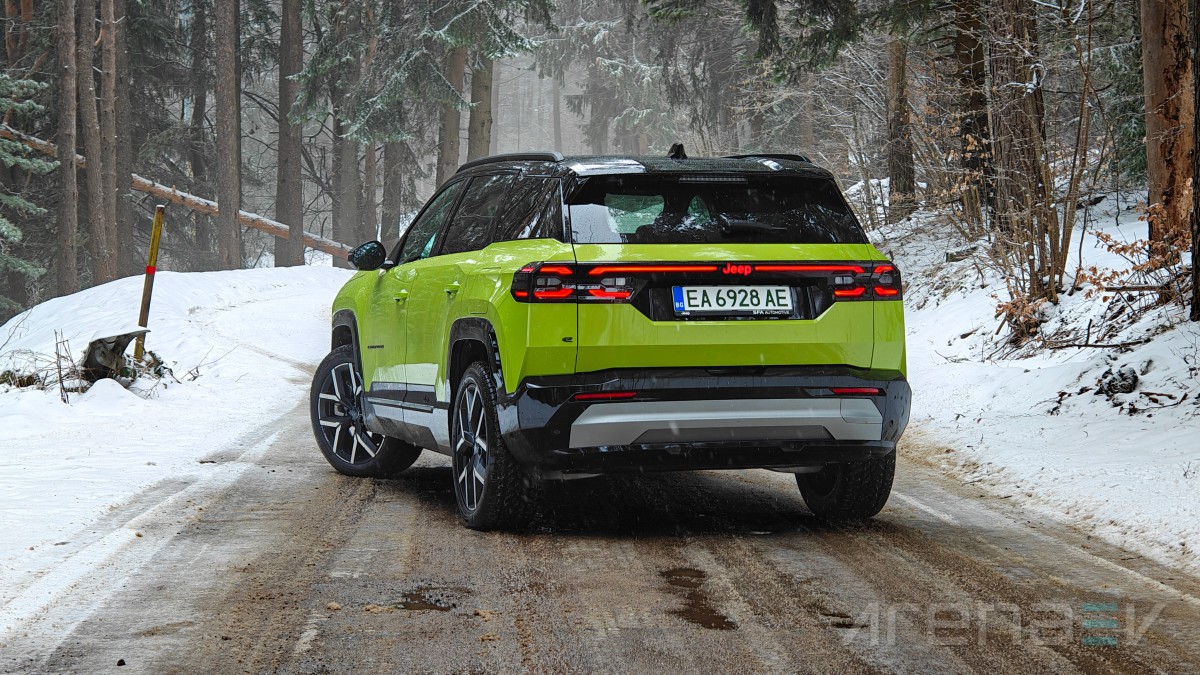
The rear of the Jeep Compass doesn’t look as rugged and mature as the rest of Jeep’s lineup. It has a softer design with a rounded tail and fewer details to make it stand out.
By no means is the rear of the New Compass ugly but it doesn't induce that same sense of rugged superiority as the rest of the exterior. The rear bumper lacks details and protrudes way too high into the tailgate, which likely helps with off-roading but doesn't look great.
The tail light bar splits into two on each end to create a pretty look, but it coincidentally almost matches Dacia's new logo. Thankfully, the word "Jeep" lights up as part of the tail light so you won't be confusing this one for a Dacia.
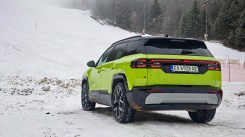
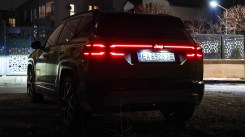
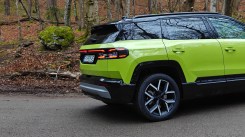
Jeep Compass e rear
Despite its massive appearance, the Jeep New Compass is actually still a relatively compact SUV in terms of size. At 179.2 inches in length it is shorter than most rivals and that makes it much more appealing for urban usage. This is another occasion where the high ground clearance can prove key, while the FWD-only drivetrain won't really matter.
Interior
The Jeep Compass e looks modern on the inside without shining particularly. There are a lot of cheap plastics in key areas, but everything feels solidly put together and with convenience in mind.
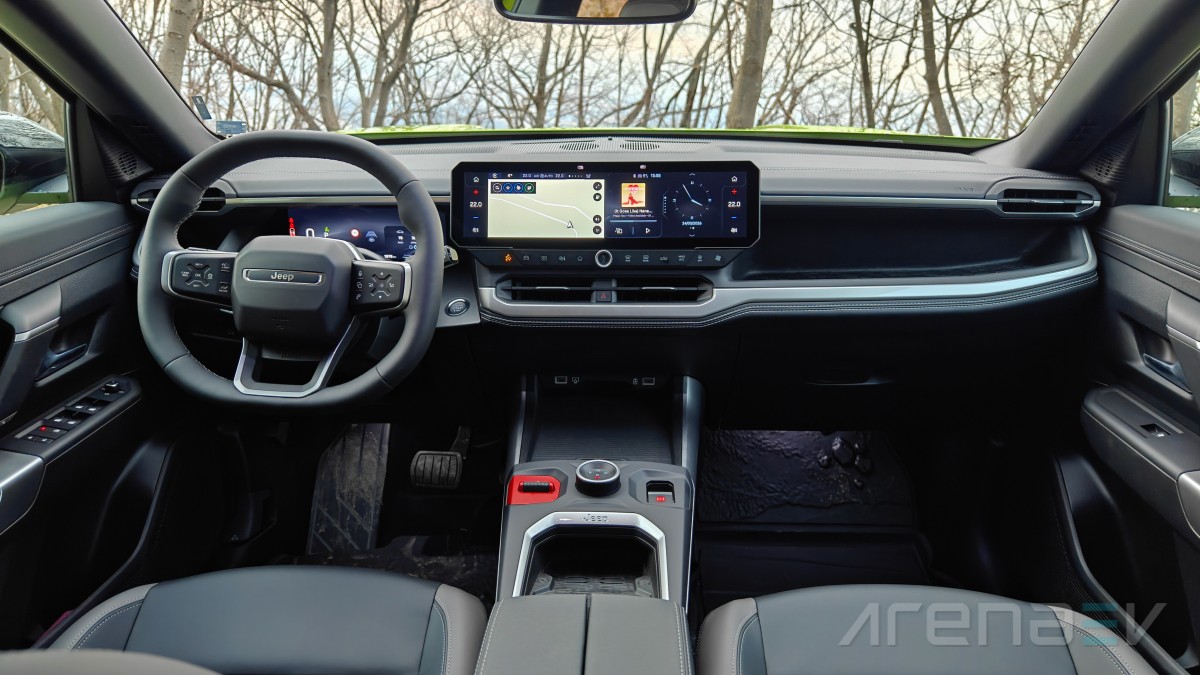
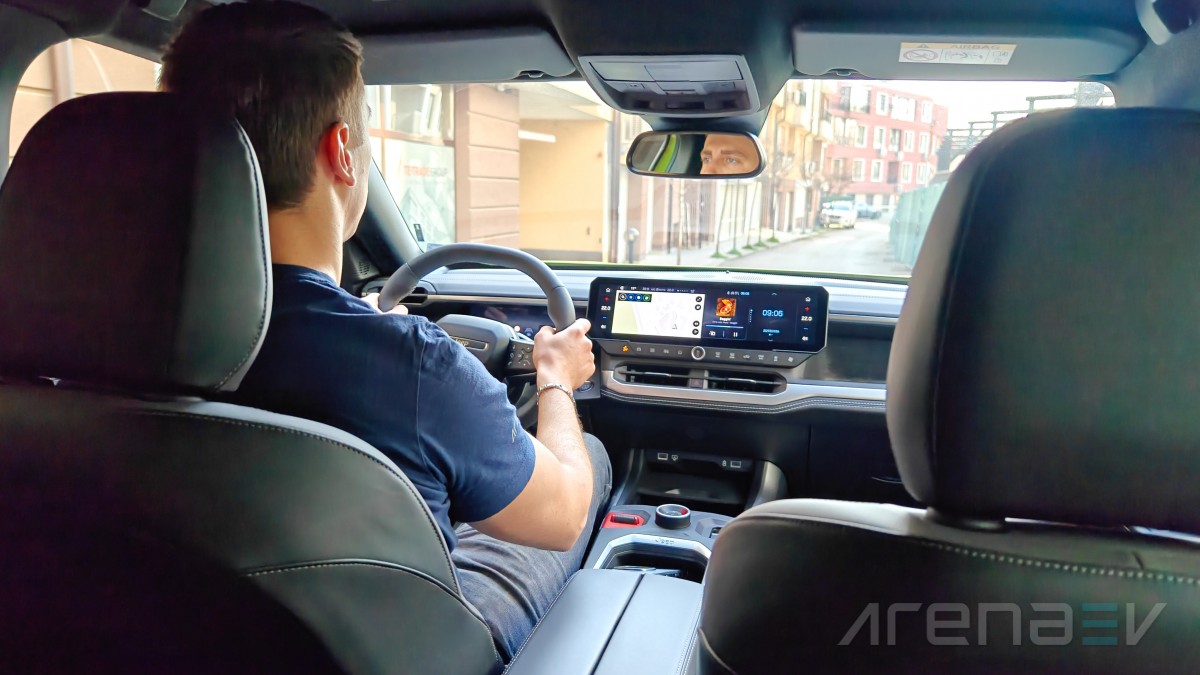
Starting off with the steering wheel - it is a rounded hexagon rather than a circle and that makes it slightly harder to use, especially while maneuvering. The buttons on it feel cheap and will likely get sticky with time, but for now work well and are easy to decipher.
Behind it is the driver display, which is large and offers a lot of customization options. Many rivals either omit this display entirely or make it very basic, while Jeep has taken the time to make it usable and user-friendly.
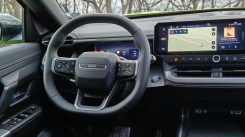
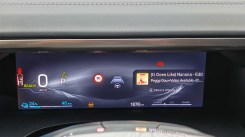
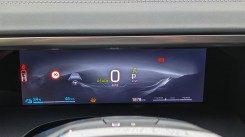
Steering wheel and instrument cluster
In addition to the buttons on the wheel itself, two buttons, mounted on the ends of the steering wheel stalks, control the information displayed on the gauge cluster.
A head-up display is also offered but our test unit sadly didn't have it.
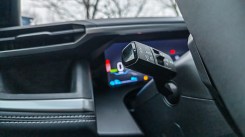
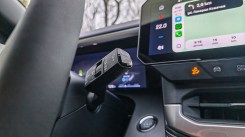
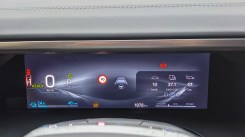
Stalk buttons to control the gauge cluster
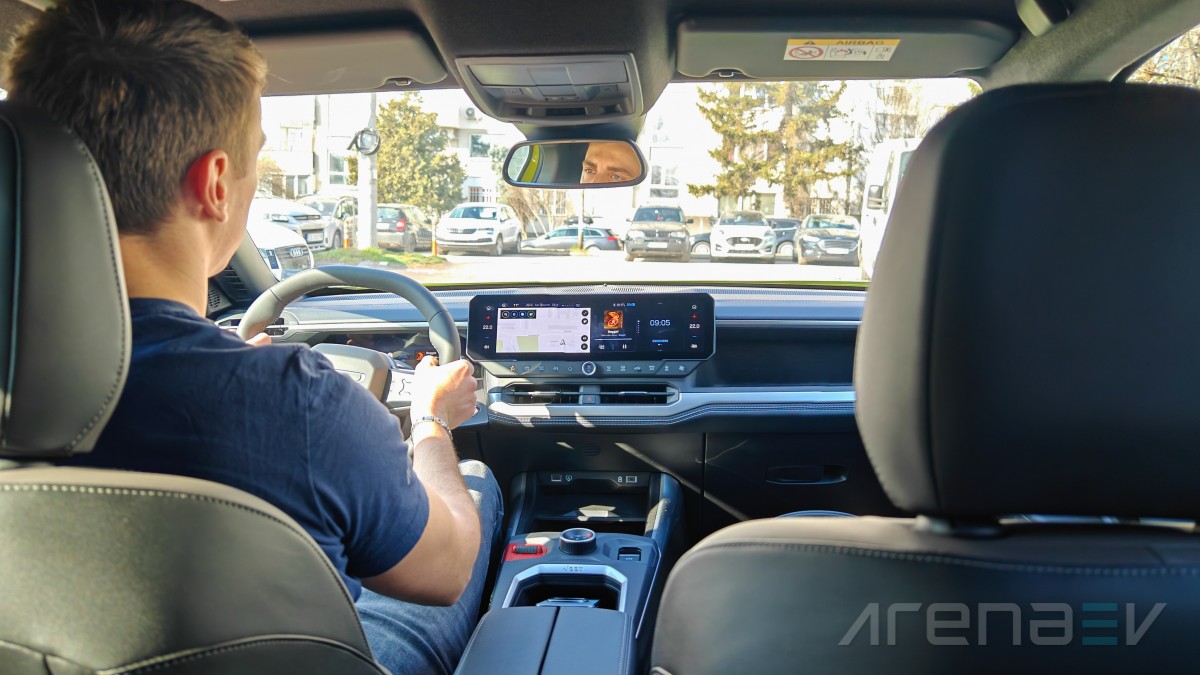
The center display is very wide, but not particularly tall. This allows it to have two menus displayed on its two halves, but the downside is that the font is always small and hard to read while driving.
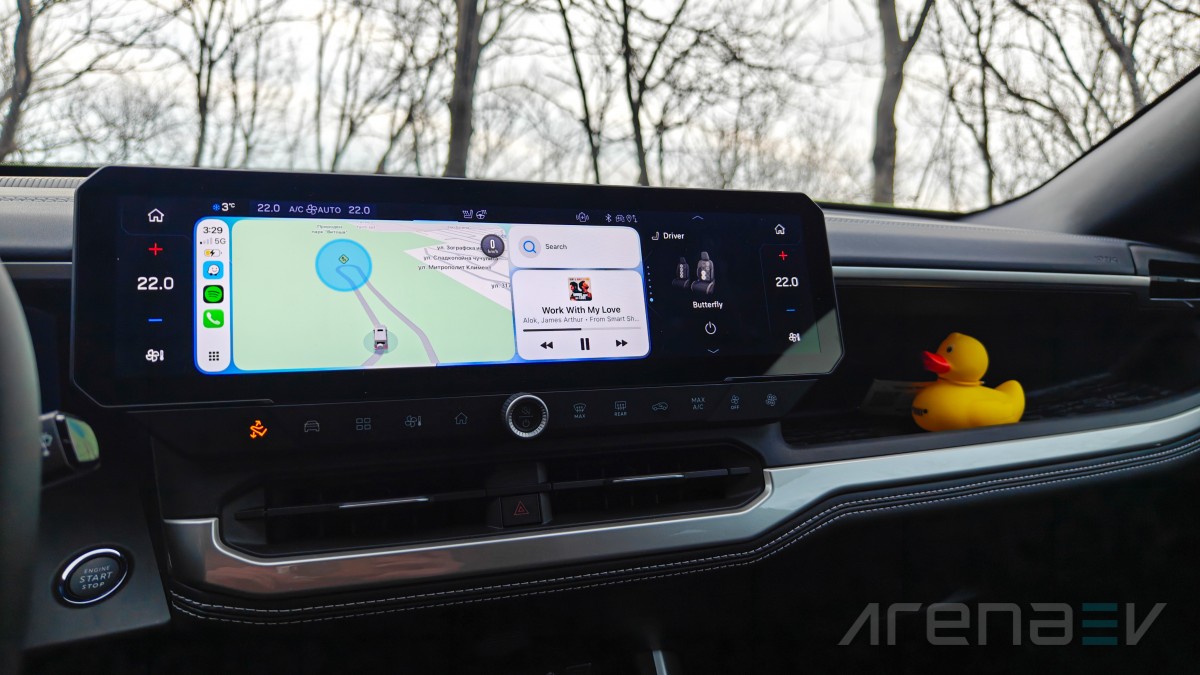
Below the main screen is a row of buttons that controls some frequently-used A/C features, as well as the stereo. The paddles behind the steering wheel control the levels of recuperation, but it's the button on the far left of this row that enables one-pedal driving.
In front of the front passenger is an open pocket for storing items, but you have to be careful with it as items might fly out easily. The ducks you see in our test unit come with all new Jeeps as part of an old tradition of Jeep drivers gifting each other rubber ducks.
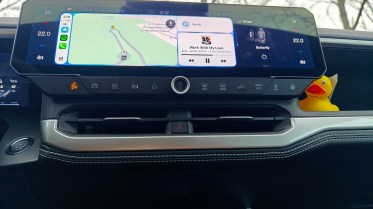
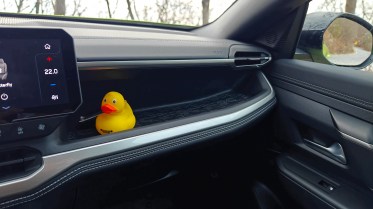
Jeep ducks
The center console starts off with two USB-C ports, followed by a huge storage area with two cup holders.
Where a gear lever would be in most vehicles, Jeep uses a gear scroller, which we find easier to use. On its left, painted in red, is the Selec-Terrain button that alternates between the sport, auto, snow or sand/mud modes.
Right above that area is a wireless charging pad that is slightly tilted inside to not allow your phone to fly off the pad and also not tempt you to look at it while driving.
The armrest storage space is deep and well laid-out, offering excellent practicality.
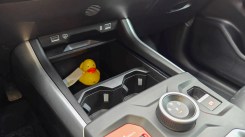
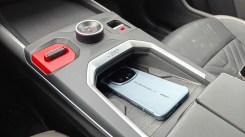
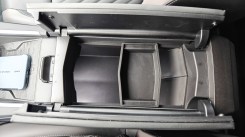
Jeep Compass e's center console
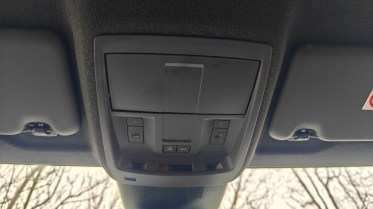
The dome light area is made of very cheap plastics but the glasses holder is covered in Alcantara inside to both protect your glasses and not have them rattle while driving.
Our test vehicle didn't come with a sunroof but one is available as an option.
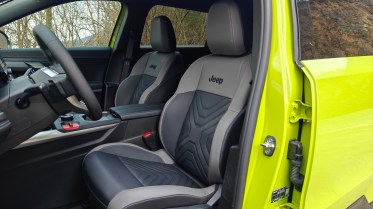
The optional leather seats our test unit had are comfortable and offer nice luxury features like heating, cooling and massage. They also come in a two-tone black and beige color scheme, which is weird as no other part of the interior is beige in any configuration possible.
The optional Focal sound system delivers impressive audio quality, but its visual execution feels less convincing. The speaker grilles are finished in black plastic throughout, which gives them a rather understated appearance that does not quite reflect their premium positioning.
The door cards utilize some soft plastics in the places you most frequently touch, but the lower parts and the window buttons are made out of some of the worst possible plastic we've seen, spoiling what could easily be a wonderful door assembly.
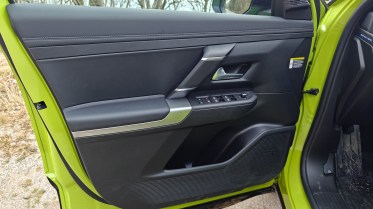
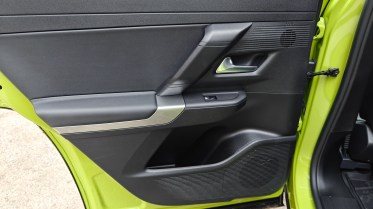
Jeep Compass e door cards
In the back seats, passengers get plenty of space. Our reviewer stands at 1.95 m (6'4") tall and can sit behind his driving position with ease. Due to the floor-mounted batteries the legs of the passengers around back will slightly lift off but that's common with EVs.
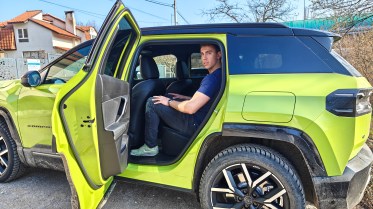

Jeep Compass e rear seat space
Rear seat passengers don't get much in terms of features, though. Two USB-Cs, a couple of vents and cupholders are all the things of note, but that is to be expected in this segment.
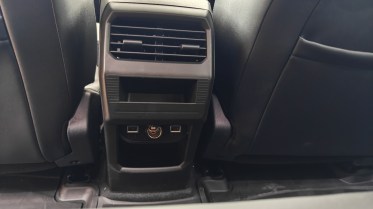
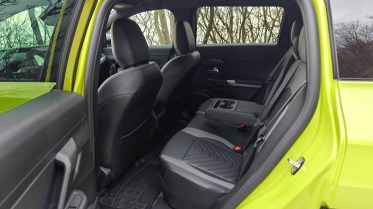
Jeep Compass e rear seats features
Storage & practicalities
The rear door of the Jeep New Compass e opens to reveal a large trunk with a cargo space of 19.4 ft³. That is among the higher in the class, just a few liters behind the best out there. It is important for that segment to be versatile and the Compass strikes a great balance between interior space on both rows and trunk size.
The trunk floor has two levels, so you can either use the bottom compartment as storage for smaller items and the charging cables or lower it down to allow bulkier items to be carried.
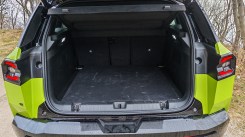
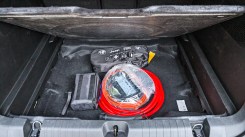
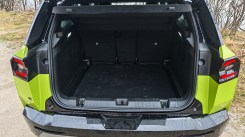
Jeep Compass e trunk
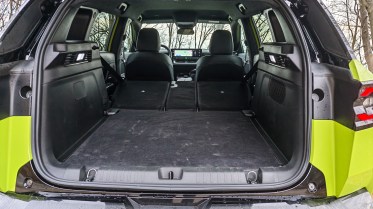
With the floor on its higher level, the rear seats fold flat and ensure massive loading space for items inside. Due to the boxy design most of that space can be utilized for carrying large items, adding to the practicality.
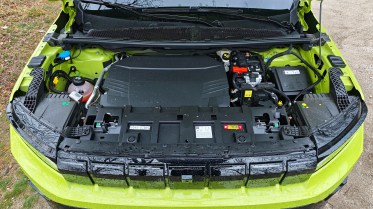
Sadly, there is no frunk (front trunk) under the hood, even though it looks like there is plenty of space available for one.
Driving experience
Jeep knows the Compass is a tall car and will never be a track monster. Thus it focused on making it drive as easily as possible. Steering feels assisted but not distant enough to create numbness. There is still some feedback from the wheel, allowing you to understand the conditions underneath the tires.
The suspension is not the most comfortable with potholes, yet leans a lot into corners. Even after looking at its size and high clearance we expected a bit more dynamic prowess. That isn't to say the Compass e feels dangerous or bad to drive - the low center of gravity enabled by the battery actually offers decent stability.
We got to experience one of the very last snowy days for the year while doing our review of the Jeep Compass so we managed to test how capable it is in those conditions. The high temperatures gave the road a coverage of heavy and wet snow, which is normally some of the most slippery stuff you can get. Despite the challenging conditions and the lack of AWD, the Compass e powered through the drifts and led us to our final destination.
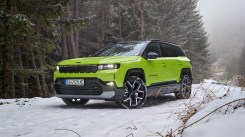
Jeep Compass e FWD in the snow
At one point we stopped on a hill to test if the Selec-Terrain feature worked as promised and it actually came in clutch. Without it the Compass struggled to take off but once enabled, it started slowly moving forwards and gaining traction. It is still not the car with the best traction on the road but the upcoming 4Xe AWD version may well be up there!
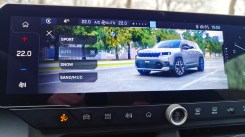
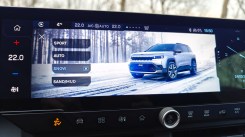
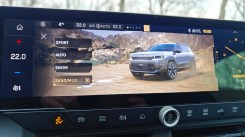
Jeep Compass driving modes
The overall sensation as a driver is that of a balanced and well-rounded vehicle. It is predictable and calm, making it a wonderful choice for a daily used vehicle that can handle anything thrown at it.
As for the driving assistants, they are easy to turn off. It is mandated for some of them to turn on at every start of the vehicle, but Jeep eased the procedure for disabling them tremendously. There is a physical button that pulls up the systems that are most frequently misbehaving, whereas a full list of systems is available when pressing the next button.
We also love seeing Apple CarPlay integration into the gauge cluster display. This way you can have the navigation stay in your view, while the main screen can be used for other functions or entertainment.
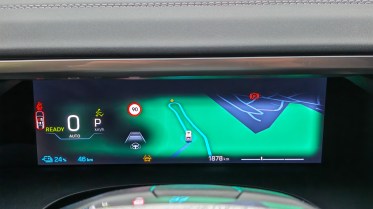
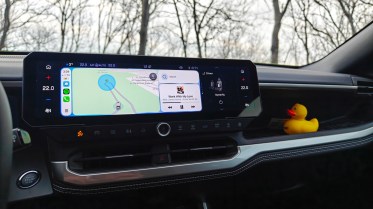
CarPlay navigation gets shown in the gauge cluster of the Jeep Compass e!
Ride comfort
The New Compass is comfortable but not amazingly so. It drives well over rougher terrains and eliminates most of the bounces inside. However, on smoother surfaces, whenever you go over smaller bumps or ruts at speeds, the suspension feels crashy and unbalanced. These get translated inside and all passengers can feel them, which is far from the best even in this segment.
Tech features
Jeep has never been a technological pioneer, but once again proves it can utilize the available resources greatly, leaving almost no room for complaint in terms of technological capabilities.
The home menu offers plenty of shortcut widgets, which can also be customized.
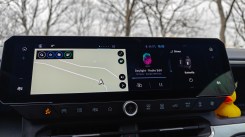
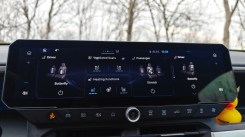
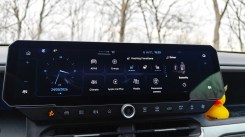
Home screen menus
As we already mentioned, the right side of the display works independently and can be used as a shortcut for features or readouts. It is also customizable and we love that it offers quick access to frequently used functions without having to delve deep into menus and get distracted while driving.

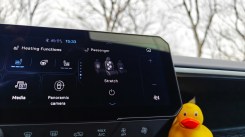
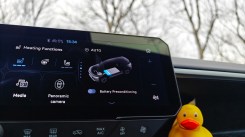
Right side menus are always there
If the fixed buttons on each side of the display and below it are not enough, you can control even more settings for the air conditioning by entering a menu on the infotainment.
The built-in navigation is borrowed directly from other Stellantis products and works just as well. It isn't flashy and has a restrained design, but works great and suggests charging stops along the route if needed.
A swipe-down menu is available just like in a smartphone to offer even more customizable widgets, available at all times. It also displays messages and offers from the connected services.
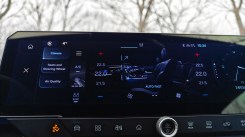


More features
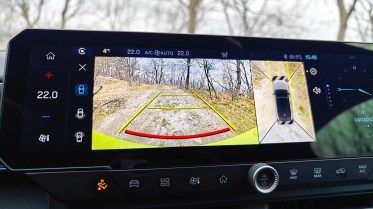
The camera system has great image quality, but due to the short and wide display, the image is small and requires more attention compared to rivals with taller screens.
Apple CarPlay works seamlessly and connects instantly every time you enter. With the gauge cluster incorporation, it almost completely eliminates the need for any further infotainment.
Even more features
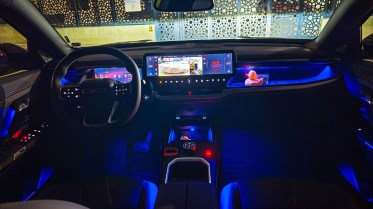
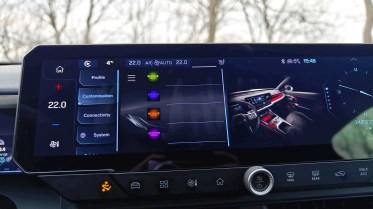
Ambient lighting is excellent for the segment and a lot of surfaces light up, creating a cozy atmosphere inside. The color palette is more subdued than in some rivals, and transitions between similar shades, such as purple and blue, are relatively subtle rather than striking.
Ambient lighting
Cabin noise
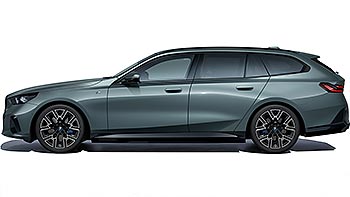
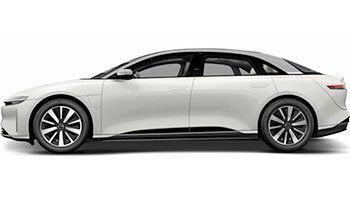
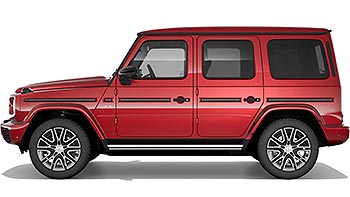
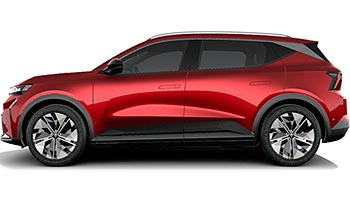
The excllent build quality of the Jeep Compass helped it ace our cabin noise test. It performs adequately at low speeds compared to rivals and starts beating them as speeds increase, making it a great choice for longer drives.
Cabin noise test results
- 37 mph
- 56 mph
- 81 mph
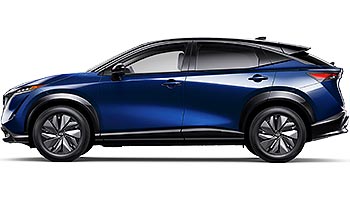 Nissan Ariya 87 kWh FWD
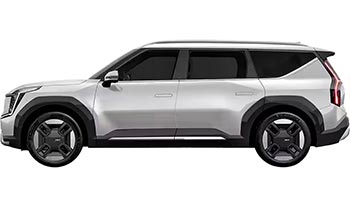
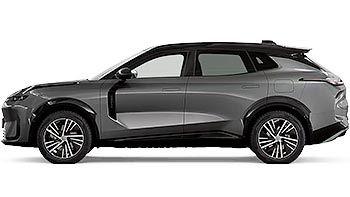
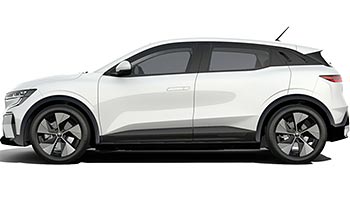
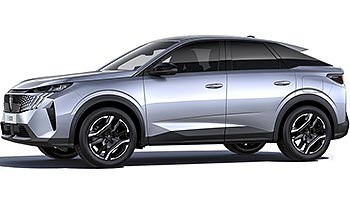 Peugeot e-3008 GT Electric
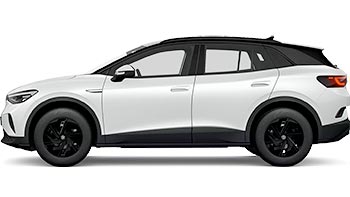 Volkswagen ID.4 GTX
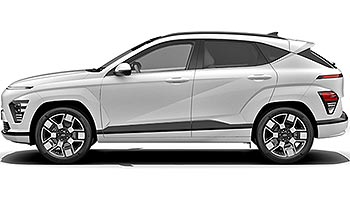 Jeep Compass FWD
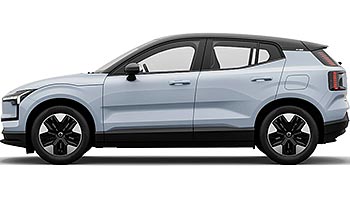
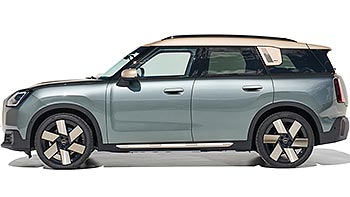 Mini Countryman SE ALL4
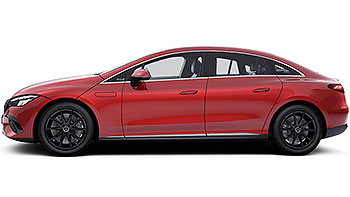
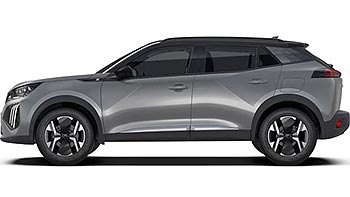
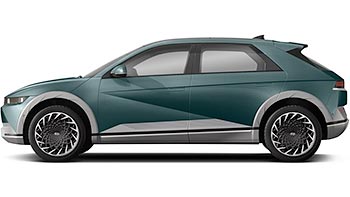 Hyundai Ioniq 5 77.4 kWh AWD
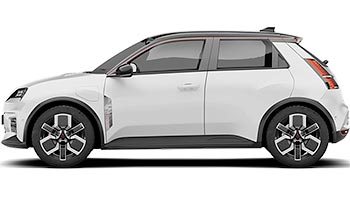
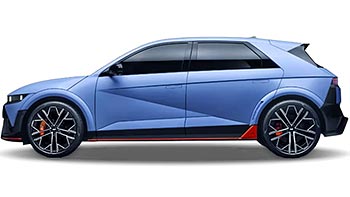
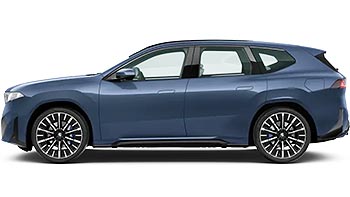
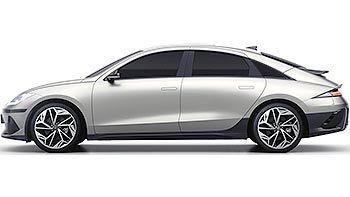
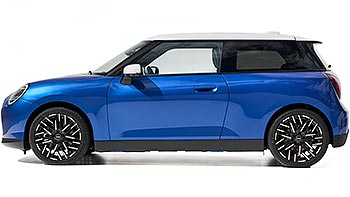
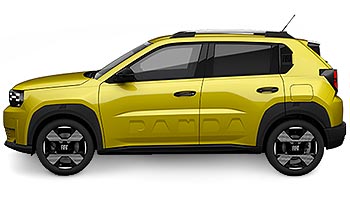
 Tesla Model Y Long Range (2023)
Sound level tests are carried out with a specialized sound level meter placed in the car's cupholders. The test is conducted with air conditioning and radio off and while maintaining a steady speed.
Acceleration and braking
With 213hp supplied only to the front wheels, we never expected wonders in terms of acceleration from the Jeep New Compass e. It sprints from 0 to 62 mph in 8.32 seconds, which is slightly quicker than the manufacturer advertised time of 8.5 seconds. At no point does the Compass e feel slow or in normal daily situations and even at higher speeds it keeps up with traffic just fine.
0-62 mph acceleration test results
Hyundai Ioniq 5 77.4 kWh AWD
Tesla Model Y Long Range (2023)
Mini Countryman SE ALL4
Volkswagen ID.4 GTX
Nissan Ariya 87 kWh FWD
Jeep Compass FWD
Peugeot e-3008 GT Electric
The Compass' brakes perform reasonably under pressure with a 62 mph to 0 stop taking 39 meters (127'11"). With stickier summer tires an even better result is possible.
Braking distance test results
Nissan Ariya 87 kWh FWD
Hyundai Ioniq 5 77.4 kWh AWD
Peugeot e-3008 GT Electric
Volkswagen ID.4 GTX
Tesla Model Y Long Range (2023)
Jeep Compass FWD
Mini Countryman SE ALL4
Acceleration and deceleration are measured with a RaceBox device inside the car. Testing is done with a single person inside the car, with air conditioning and traction control off.
Consumption
Given how bulky it is, the Jeep Compass e doesn't consume that much energy while moving. Its efficiency is actually superior to most rivals, however the battery capacity of just 73.7 kWh holds back its total achievable range. It would be good if a bigger battery were to be offered, as the Compass would need frequent charges on highway trips. For our detailed opinion on the Jeep Compass e’s efficiency, check out our detailed range test article.
Range test results
- 37 mph
- 56 mph
- 81 mph
Tesla Model Y Long Range (2023)
Jeep Compass FWD
Volkswagen ID.4 GTX
Nissan Ariya 87 kWh FWD
Peugeot e-3008 GT Electric
Hyundai Ioniq 5 77.4 kWh AWD
Mini Countryman SE ALL4
We measure consumption by driving at constant speeds on an identical test route during the day. Testing is conducted with air conditioning, all safety systems and radio on. The data comes from the vehicle's board computer. Specific testing parameters such as ambient temperature are mentioned in the text on a case by case basis.
Take a look at the widget below to find out the Jeep New Compass e's range in every combination of speed and temperature you might need. We've used our real world tests and a complex model to provide an estimate that should be as close to the actual performance as possible.
Charging speed
The Jeep Compass e's maximum charging speed of 160 kW is pretty good, but the charging curve starts dropping very early and the 20% - 80% charge takes the pedestrian 30 minutes. We had to do that testing while the weather outside was at a freezing point and the battery was not fully preconditioned, which meant we needed 45 minutes in the suboptimal conditions, which is rather long in today’s world.
Jeep hasn't borrowed the V2L system from the Peugeot e-3008 either, even if the two are essentially the same vehicle underneath. Multiple rivals also offer that feature, which may prove useful in many situations, especially given the outdoorsy nature of the Compass.
Competition
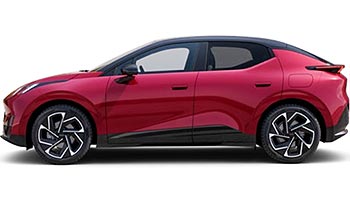
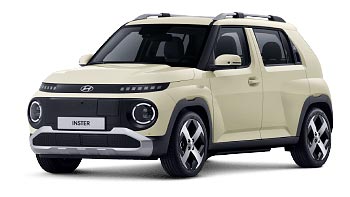
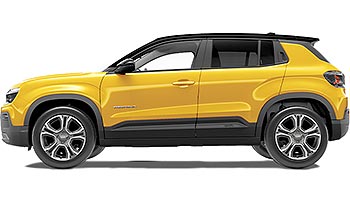
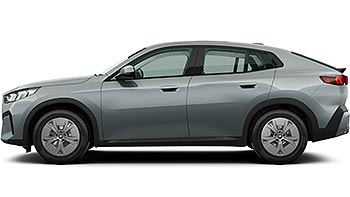
The Jeep Compass e is positioned in one of the most heavily saturated segments, but makes a good case for itself. It is rugged and distinctive on the outside, while remaining highly practical inside. There is a lot of good tech available, combined with an easy driving experience.
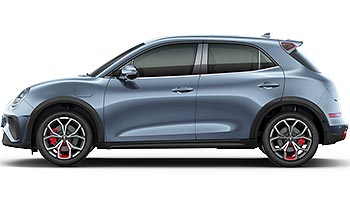
The first rival we chose for the Jeep Compass e is its sibling - the Peugeot e-3008. Both vehicles sit on the same platform and share multiple components. The battery of the Jeep is slightly bigger but the Peugeot can be ordered with AWD or as FWD with an even bigger 98 kWh battery pack that dwarfs everything else in the segment. In terms of everyday experience we'd give a slight edge to the Jeep.
The second rival you should consider is the Nissan Ariya. It is also offered in many more battery and motor combinations but it's an older drivetrain with far higher consumption. The Ariya has the better interior materials and even more interior space but lacks in terms of infotainment capabilities or storage space.
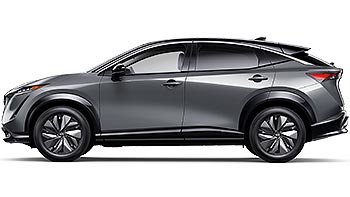
Peugeot e-3008 230 FWD 2023 - • Nissan Ariya 87kWh 2020 -
Verdict
In the late 90s Jeep's slogan in Europe was "Everybody can make a 4WD vehicle, only we can make a Jeep." We have to wait a bit more to test how capable the Jeep Compass 4Xe version with AWD is but even the Jeep Compass e impressed us with its FWD.
Despite sharing key components with other Stellantis models, the Jeep Compass retains a distinct Jeep identity and manages to stand out in a crowded segment. It may not lead the class in any single area, but it avoids notable weaknesses across the board. Versatility remains a crucial factor in the midsize SUV segment, particularly in Europe, and the Compass delivers a well balanced package that meets the wide ranging demands of modern buyers.
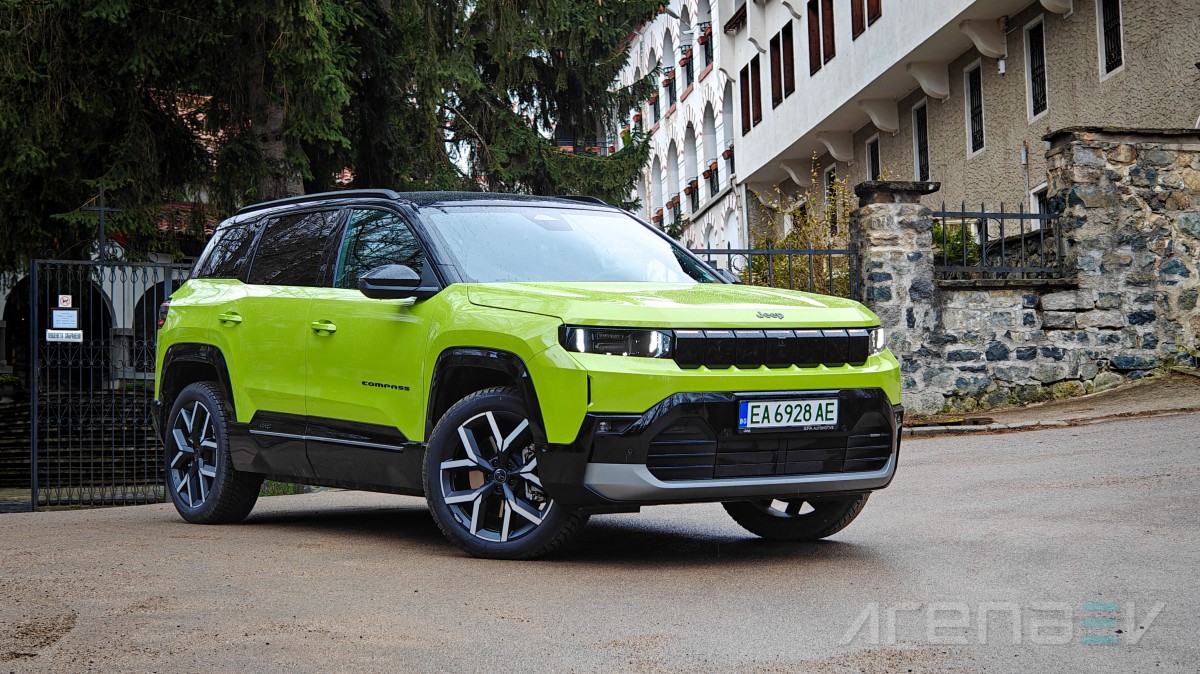
For buyers in this segment with a taste for something more distinctive, the Jeep Compass e is worth considering, particularly in the striking Hawaii green color of our test car.
Pros
- Huge ground clearance.
- Compact outside, spacious inside.
- Intuitive infotainment.
- Distinctive styling.
- Wonderful optional equipment.
- Plenty of easter eggs.
- Easy to disable ADAS system.
- Highly customizable infotainment.
Cons
- Small battery for the size.
- Only offered in FWD (for now).
- Low range on a single charge.
- Many cheap and hard interior materials.
- Hard to read infotainment display.
- No V2L charging.
Related

Reader comments
- vik 0
We compare all vehicles we have tested under the same conditions. However, Tesla does not have an official dealership presence in Bulgaria, which makes access to the latest models more challenging than with other brands. As a result, our Tesla tests ...
- 27 Apr 2026
- gxI
- Anonymous
You are still comparing brand new 2026\2027 cars to a 2023 Model Y and a used 2018 Tesla Model S 75D. You are intentionally doing this just to sway public opinion. Shame on you!
- 27 Apr 2026
- AZd