QuantumScape pitches peace in the solid-state battery war - always read the small print
Any EV owner quickly learns to ignore the range estimates from dealership brochures. When the rain turns to sleet, and you have the cabin heater, heated steering wheel, and rear demister running full blast, a modern battery pack shows you its true colors. Laboratory energy density charts, or a CEO promising that a miracle battery is three years away, do not matter to drivers. What matters is weight, cold-weather performance, and how long you have to wait at a charging station for the electrons to do their job. The battery industry promised us that solid-state cells will fix all of these problems at once, but the tech has stayed locked behind laboratory doors. Until now, apparently.
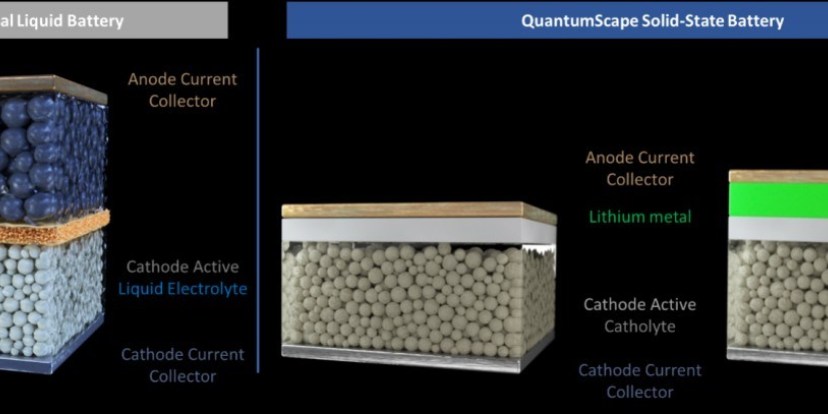
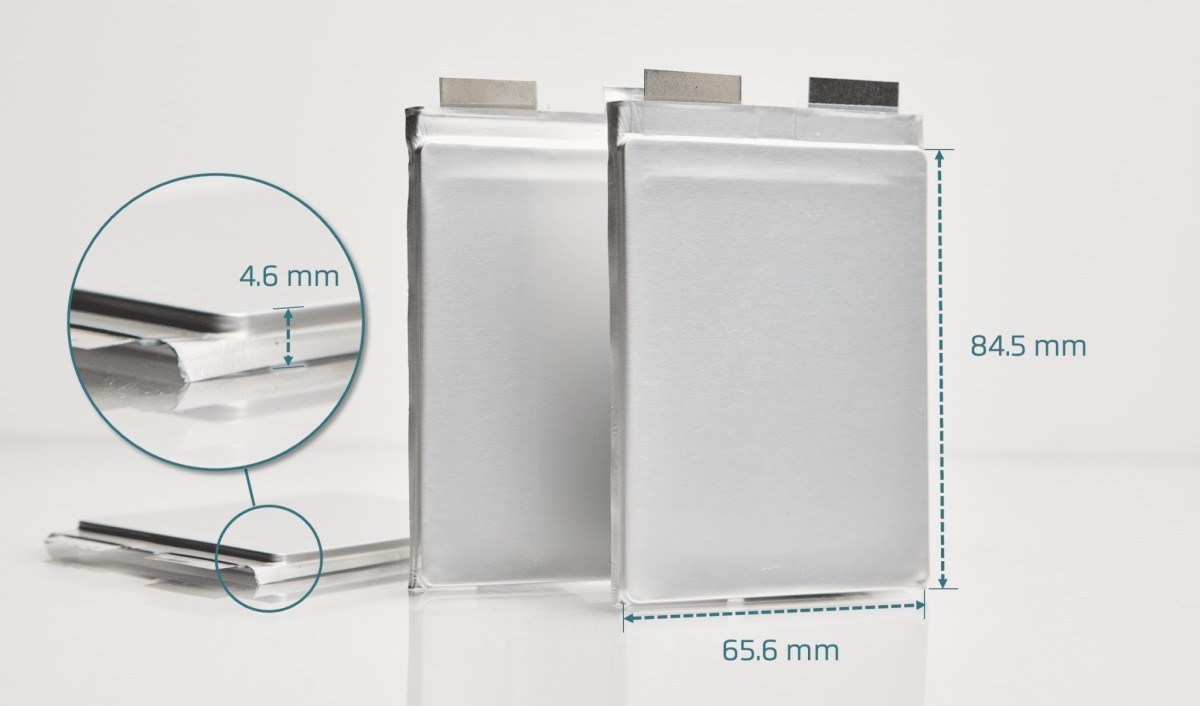
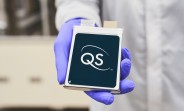
California-based battery developer QuantumScape has unveiled a new cell architecture called Osprey, and it comes with a surprising admission hidden inside its technical white paper. The company has marketed itself for years as the premier developer of solid-state lithium-metal batteries. Yet in detailing Osprey, QuantumScape states plainly that its first commercial product, the QSE-5 cell (already shipping in small sample batches from its San Jose pilot line), is not actually an all-solid-state battery. The QSE-5 uses a solid ceramic separator and an anode-free design where metallic lithium sticks directly onto the separator during the first charge, but its cathode still relies on a conventional high-nickel NMC structure soaked in a liquid catholyte. I hate to be a party pooper, but technically, that makes the QSE-5 a hybrid or semi-solid cell.
 Source: QuantumScape
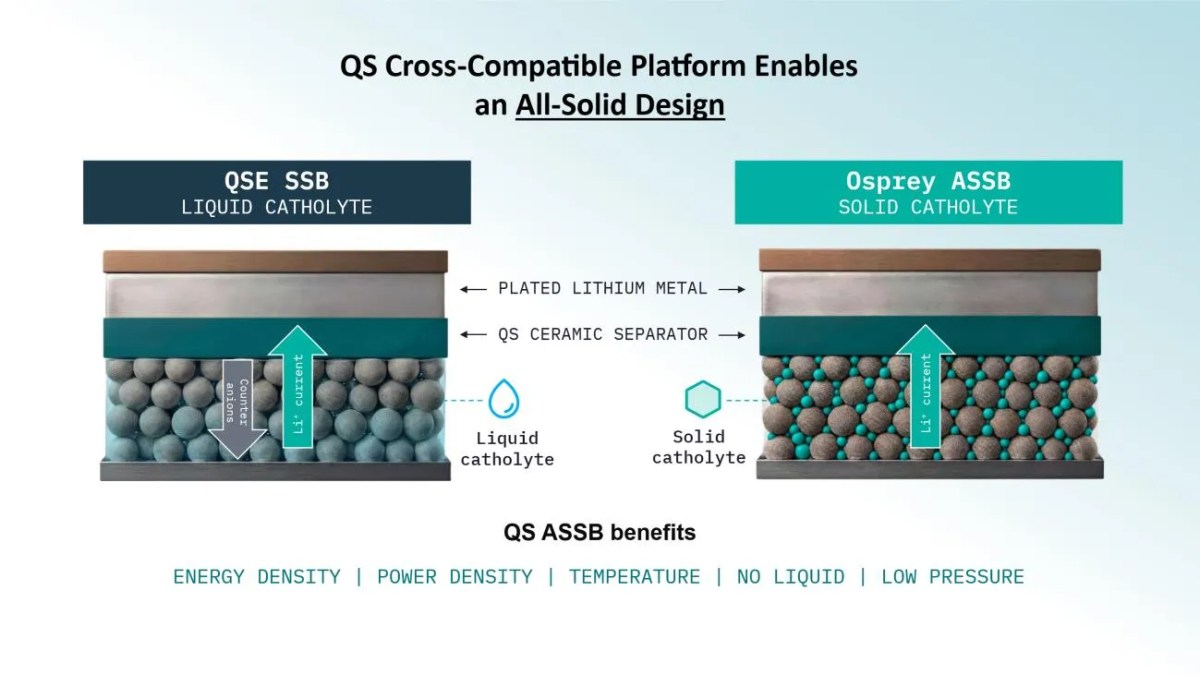
But Osprey is the new architecture that finally removes that remaining liquid from the equation. It keeps QuantumScape's signature ceramic separator and anode-free configuration, but swaps out the wet cathode for a solid sulfide electrolyte. On the surface, this sounds like a simple chemical substitution, but in the world of battery engineering, it is a major peace offering. QuantumScape used to criticize sulfide electrolytes favored by industry heavyweights like Toyota, Samsung SDI, BYD, and Factorial. QuantumScape's engineers argued that sulfides are fundamentally flawed when used as separators because they react badly with lithium metal, grow short-circuiting dendrites during fast charging, and need huge clamping pressure to maintain internal contact.
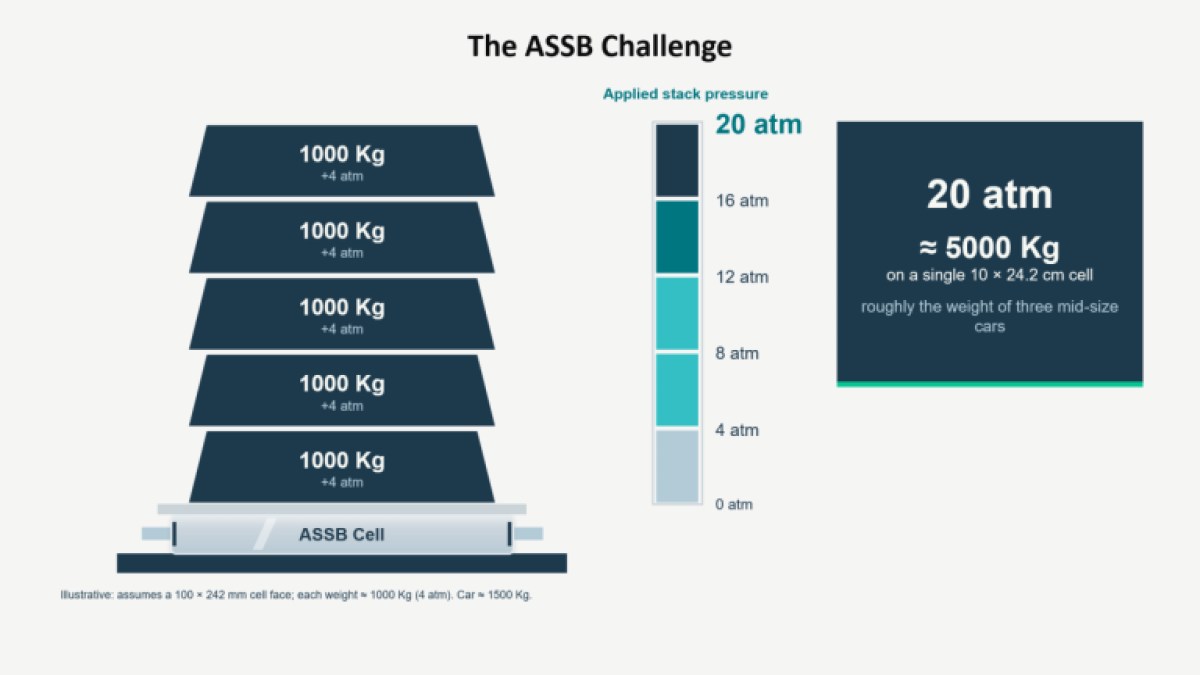
That clamping pressure is a giant mechanical headache that ruins how an electric car drives and handles. Many laboratory sulfide cells need 20 to 100 atmospheres of external pressure to function without delaminating. As QuantumScape points out in its documentation, applying just 20 atmospheres to a modest cell patch measuring 3.94 inches by 9.5 inches needs roughly 11,020 lb of clamping force - equivalent to stacking two and a half family SUVs on top of a single battery pouch. Even China's FAW boasted about cycling large-format sulfide cells at 50 atmospheres, framing that immense squeeze as a low-pressure victory. To keep that kind of force inside a road car, engineers have to build battery cases out of thick steel end plates and heavy tie rods.
 Source: QuantumScape
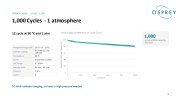
QuantumScape's pitch with Osprey is that you can avoid the heavy steel case by letting each material do what it does best. By confining the sulfide to the cathode - where it excels at shuttling lithium ions - and letting the stiff ceramic separator handle the reactive lithium metal anode, Osprey operates at just one atmosphere of pressure. In its headline test, QuantumScape took a two-layer Osprey pouch with a cathode measuring 1.97 inches by 2.56 inches and ran it through 1,000 full charge and discharge cycles at room temperature under one atmosphere, retaining about 80% of its capacity. Nobody else in the sulfide camp has published data showing 1,000 cycles at zero external mechanical pressure with a lithium-metal anode - and that is a genuine milestone.
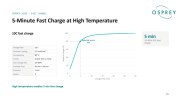
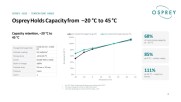
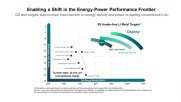
But as usual, a healthy dose of skepticism is needed when you look closely at the rest of the press release numbers. QuantumScape highlights a five-minute fast charge from 10% to 80%, and cold-weather operation down to -20ºC and a projected energy density of 1,100 Wh/L - it would easily eclipse the 844 Wh/L and 301 Wh/kg ratings of the QSE-5 cell. Dig into the white paper a bit deeper, and you discover these milestones were not achieved in the same cell, or under real-world driving conditions. That five-minute fast charge required heating the tiny two-layer cell to 80ºC - far hotter than any production EV thermal management system preconditions a battery pack before plugging into a DC charger. The -20ºC cold test was performed on a tiny single-layer square measuring 0.83 inches by 0.83 inches at a gentle discharge rate, where it lost nearly half its total energy, and the 1,100 Wh/L density projection came from an 0.43 inches coin cell squeezed at three atmospheres for only 100 cycles.
 Source: QuantumScape
Even the impressive 1,000-cycle durability test used a two-layer cell holding roughly 0.3 to 0.4 Ah of capacity - a commercial QSE-5 sample holds about 5 Ah, and automakers actually need much larger cells for production cars. Scaling a battery from a postage-stamp lab sample to a multi-layer automotive pack without introducing microscopic manufacturing defects is the hardest job in the industry. Even QuantumScape admits that mass manufacturing for Osprey is still in the development stage, and it has offered no timeline for when we might actually have one in a real car. After all, the company's 100 MWh pilot line for the older QSE-5 cell is only targeting production to start in 2028.
This explains why the real story behind Osprey is less about chemistry and more about corporate survival and business strategy. By framing Osprey as an open platform, CEO Siva Sivaram is pitching QuantumScape to its former rivals. Companies like Toyota (which has pushed its own solid-state launch targets from 2020 to 2023, then 2026, and now 2027 to 2028), Samsung SDI (aiming for late 2027), and BYD (targeting small batches in 2027) have spent billions developing proprietary sulfide cathodes. Rather than telling those giants to throw their research in the bin, QuantumScape is offering to license its ceramic separator to them, just as it already licenses technology to Volkswagen's PowerCo and Honda, generating $9,800,000 in customer billings last quarter.
For us car buyers, this means that the solid-state revolution will arrive as a quiet, gradual evolution rather than an overnight transformation. CATL, the world's largest battery manufacturer, warned that true mass-market solid-state packs will not arrive in showrooms until around 2030, and QuantumScape's own fine print backs up that timeline. In the meantime, conventional lithium-ion and lithium-iron-phosphate packs will continue to do their job as well as they can. But if QuantumScape's ceramic separator can save future electric cars from hauling hundreds of kilograms of heavy clamping steel, it will be worth the wait.
Related

Reader comments
Nothing yet. Be the first to comment.