The global EV adoption map just fractured in three

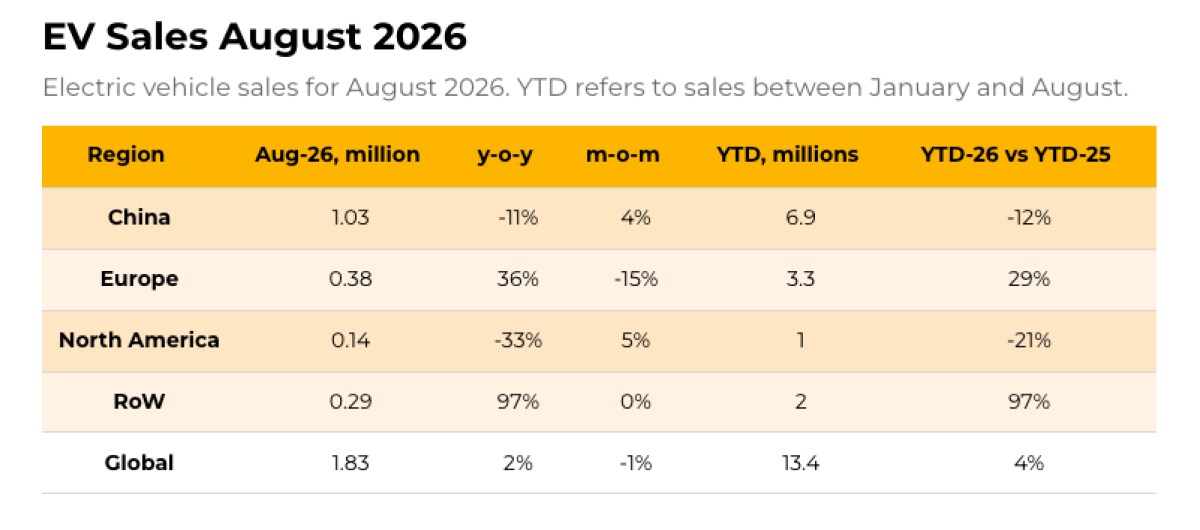
The EV sales data for August 2026 is impressive - 1.83 million plug-in vehicles finding homes worldwide, a 2% tick upward year-on-year. Sure, almost nothing to talk about. Look at the total of 13.4 million units registered year-to-date, up a modest 4%, and it seems the EV transition has settled into a predictable highway cruise. But walk through the dealership doors wherever you live, and you realize the global market is no longer moving as one. It has split into three distinct geopolitical realities, each playing by its own rules, and nursing its own wounds.
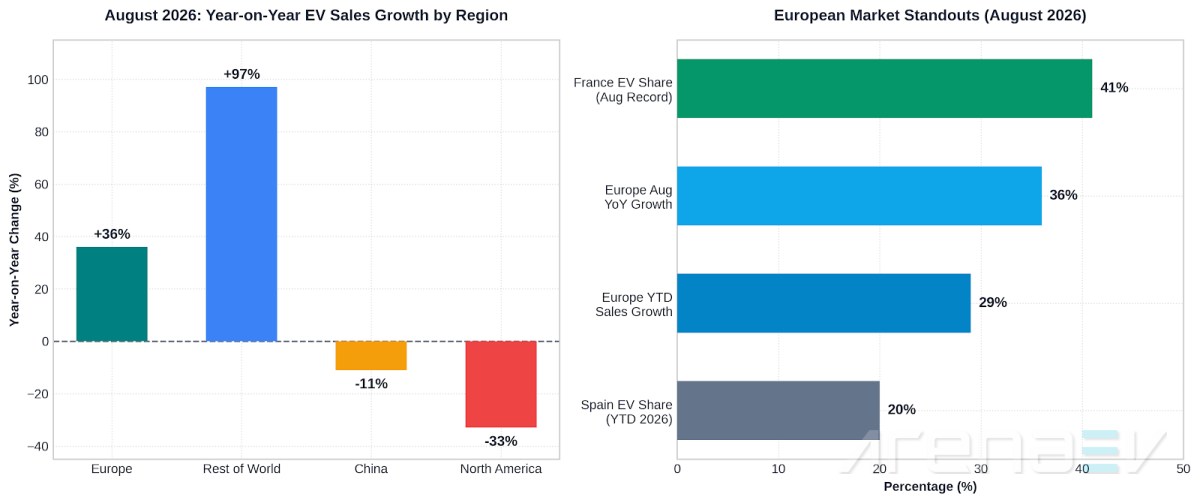
Start with the Old World, where the numbers defy every traditional piece of motor-trade wisdom. August across Europe is normally a commercial ghost town - the factory lines idle, showroom lights dim, and the entire industry packs its bags for the coast. Yet European EV registrations exploded by 36% (year-on-year) to 380,000 units. Deliveries slid 15% month-on-month because nobody signs a finance lease while sitting on a beach in the Algarve, but pushing total year-to-date growth up to 29% in the dead of summer is huge.
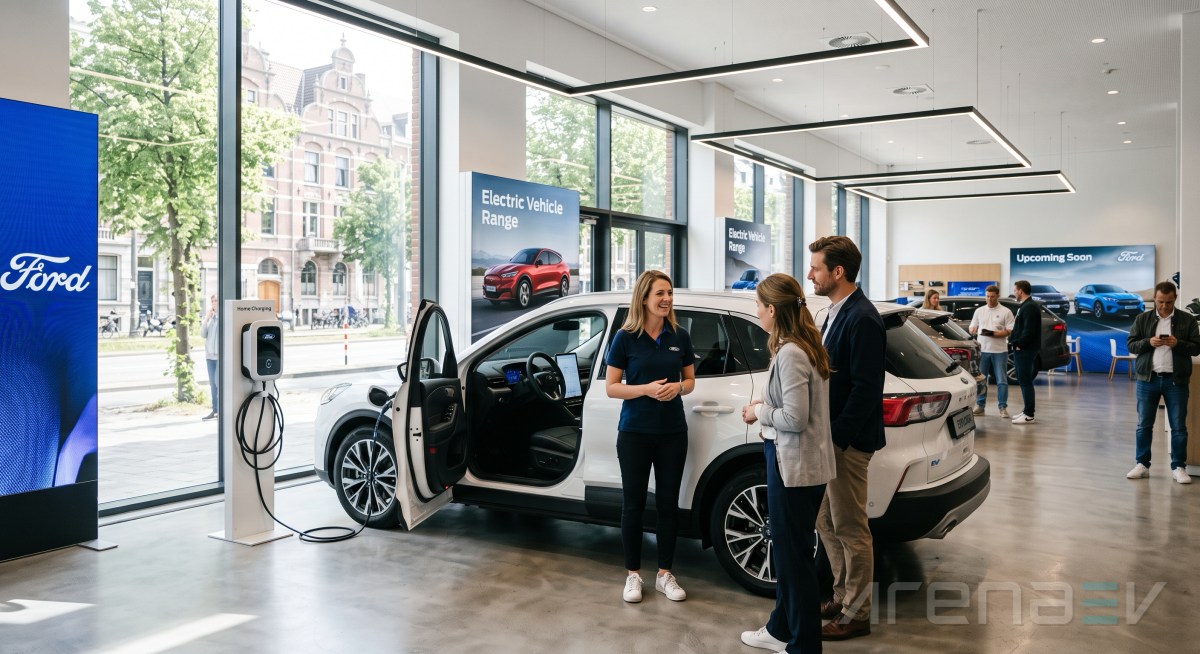
The fuel feeding this European bonfire is no secret - it is government-backed cash on the hood. Take Spain, historically one of Western Europe’s slower adopters. Madrid finally threw out the clunky, bureaucratic paperwork nightmare of its old regional MOVES III programme and launched the centrally administered "Auto+" scheme on August 4, smartly backdating eligibility to January 1. Armed with a $469 million budget through 2026, the scheme drops a base subsidy of up to $5,300 straight onto the invoice of a new electric runabout. Unsurprisingly, Spanish EV penetration climbed from 18% in 2025 to 20% year-to-date. Combine that with France hitting a 41% EV penetration rate in August alongside strong German and British numbers, and you see a European consumer base that is happily embracing the plug - as long as the state helps a bit.
The mood in North American showrooms could not be more polarized. Sales of electric cars plummeted 33% year-on-year in August to just 140,000 units - that’s the steepest tumble the region has seen all year (year-to-date volumes down 21%). If you listened only to the doom-mongers, you would think the American public had staged a mutiny against charging cables. But context, as always in this game, separates panic from reality.
The United States is going through a brutal hangover of a buying binge. Wind the clock back twelve months to August and September of 2025. With the federal EV tax credit officially set for termination at the end of September 2025, American buyers stormed dealerships like shoppers on Black Friday, pulling forward months of demand to secure that sweet government kickback before Washington pulled the plug. Measuring August 2026 against that spike makes today’s market look like a crater. Month-on-month, US electric sales actually ticked upward slightly in August. But with federal incentives gone, buyers staring at window stickers between $45,000 to $60,000 are taking a breath - and retreating straight into the arms of petrol-electric hybrids.
North of the border, the Canadian market is in its own regulatory bind. Ottawa’s first six-month import window for lower-tariff Chinese-built electric vehicles drew to a close on August 31 with 24,500 import permits up for grabs. The final score? Automakers claimed only 15,603 permits - roughly 64% of the allocation. The leftover balance of nearly 8,900 permits has now been rolled into the second window, creating a pool of over 33,000 permits running through February 2027. Rather than a sudden Canadian distaste for affordable EVs, this was an administrative bottleneck: the established brands already operating in Canada took a cautious approach, and the fresh Chinese brands planning to flood the market have yet to organize their dealer and service networks.
And finally - China, the king of the electrified landscape, where the raw numbers reveal a bit of a contradiction. Domestic sales dipped 11% year-on-year to 1.03 million vehicles in August, widening from a 5% drop in July. Pundits love to scream about popping bubbles, but that reading misses the forest for the trees. Month-on-month, domestic Chinese deliveries actually rose 4%, and New Energy Vehicle penetration stayed firmly north of 60% of the passenger car market for the fourth consecutive month. This isn’t an electric collapse - it is simply a saturated market grappling with tough year-ago comparisons. Internal combustion engines are being starved out of Chinese cities simply because the math of running an EV on cheap domestic power makes burning petrol look financially absurd.
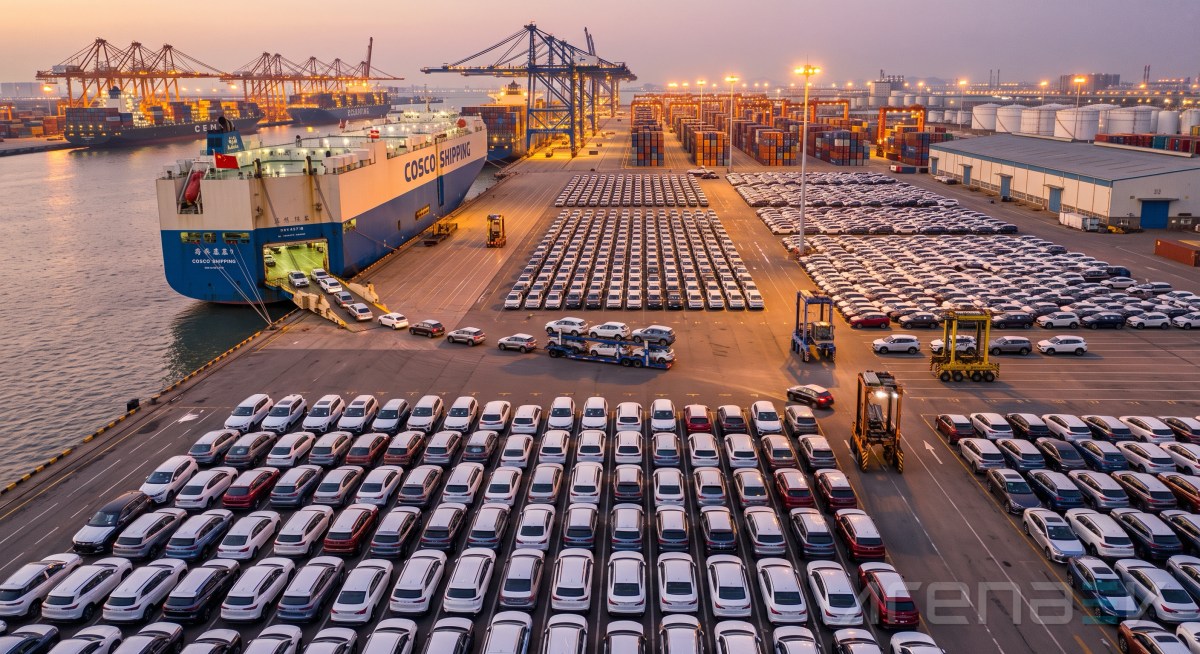
Because the domestic Chinese market has turned into a knife fight of razor-thin margins and wild discounts, manufacturers in Shenzhen and Shanghai are shifting their sales abroad. Chinese exports of New Energy Vehicles didn’t grow in August - they detonated, surging over 150% year-on-year to a monthly record of nearly 520,000 units. That pushes cumulative exports past 3.3 million vehicles for the year. BYD, China’s premier export powerhouse, has already bumped its full-year overseas sales target upward for the second time this year. If domestic demand is hitting a plateau, China’s industry will simply build transport ships and send the surplus abroad.
 Source: Benchmark Minerals
That export tsunami feeds into the most eye-opening metric in the entire report: the "Rest of the World" column. Across Southeast Asia, Latin America, and parts of the Middle East, electric vehicle deliveries exploded by 97% (year-on-year) to 290,000 units in August. These are emerging markets not held back by decades of loyalty to Detroit or Bavarian badges. Drivers there want smart, affordable, reliable daily transportation with tiny running costs - and Chinese carmakers have exactly the hardware they are looking for.
Where does this leave us? We are watching the definitive end of the global automotive monoculture. The old playbook - where an automaker could engineer a single crossover platform, stamp it out across three continents, and expect tidy sales - is dead. Today, regional politics and fiscal policy hold the steering wheel. Subsidize the cars in Madrid and Paris, and showrooms hum. Pull the safety net in Washington, and buyers run right back to hybrid safety blankets.
Related

Reader comments
Nothing yet. Be the first to comment.